Neopress growth journal
10 benefits of AI in Business: How AI can help your company grow in 2026

Artificial intelligence is changing the way businesses operate. From automating everyday tasks to understanding customer behavior, AI gives companies new ways to save time, improve their services, and find growth opportunities.
And it is no longer limited to large corporations. Small businesses, online stores, marketing agencies, and startups can now access AI tools without building their own technology.
According to the 2026 Stanford AI Index Report, 88% of surveyed organizations used AI in at least one business function in 2025, compared with 55% in 2023. Generative AI alone was being used in at least one business function by 70% of organizations.
But adopting AI is not the same as getting real results from it.
So, what can AI actually do for your business? Here are 10 practical benefits, supported by research, statistics, and real-world examples.
1. Increase productivity and save time
One of the biggest benefits of AI in business is its ability to help employees complete tasks faster.
Think about how much time your team spends writing emails, preparing reports, organizing documents, summarizing meetings, or entering information into different systems.
Many of these tasks are repetitive. AI can help automate them or make them much quicker to complete.
For example, employees can use AI to:
Draft emails, proposals, and business documents.
Summarize long reports and meeting notes.
Organize information from different sources.
Generate first drafts of presentations.
Automate repetitive administrative tasks.
The time saved can then be spent on more important activities, such as serving customers, developing products, and improving business strategies.
There is research showing measurable productivity gains. A study published in The Quarterly Journal of Economics in May 2025 examined 5,172 customer support agents using a generative AI assistant. Researchers found that AI assistance increased the number of customer issues resolved per hour by 15% on average.
McKinsey's 2026 State of AI survey also found that 80% of respondents said AI had improved their individual productivity.
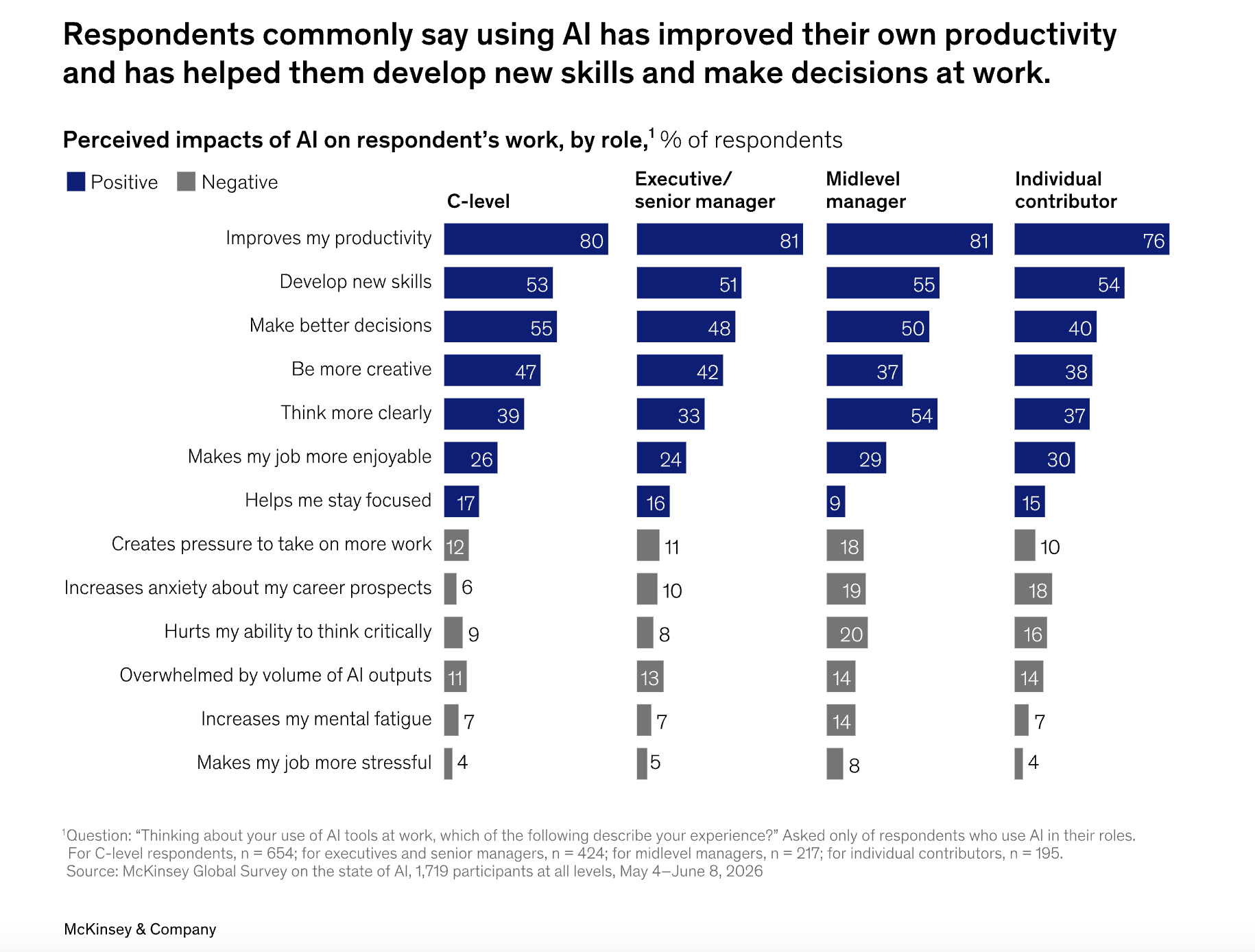
These results do not mean every employee will become 15% or 80% more productive. They show how AI can improve specific tasks and help people work more efficiently.
What this means for your business: You can reduce the time spent on repetitive work and give your employees more room to focus on tasks that require human judgment and expertise.
2. Make better business decisions with data
Running a business involves making decisions constantly. Which product should you promote? Why are sales decreasing? Which marketing campaign brings the most customers? Where are you losing money?
The challenge is that useful answers are often hidden in large amounts of data.
AI can analyze information from sales reports, customer feedback, website analytics, and other business systems to help you identify patterns and understand what is happening.
Want to learn how AI can help you understand your website performance and attract more visitors? Explore our guide on Best ways to increase website traffic by AI: 7 strategies to grow your online visibility.
For example, an online store could use AI to compare its sales and website traffic. It might discover that one product receives many visits but very few purchases, while another attracts fewer visitors but generates more revenue.
This can help the business investigate whether the problem is the product description, pricing, images, or checkout process.
AI can also help you:
Identify changes in sales and customer behavior.
Compare marketing campaign performance.
Find products that are selling better or worse than expected.
Analyze customer reviews and feedback.
Explore possible outcomes before making a decision.
This is becoming an increasingly important use of AI in business. According to a 2026 Capgemini Research Institute study, 47% of surveyed senior executives reported improvements in the quality of their decisions after using AI. The research highlights how AI can help leaders evaluate information, explore different scenarios, and make more informed strategic choices.
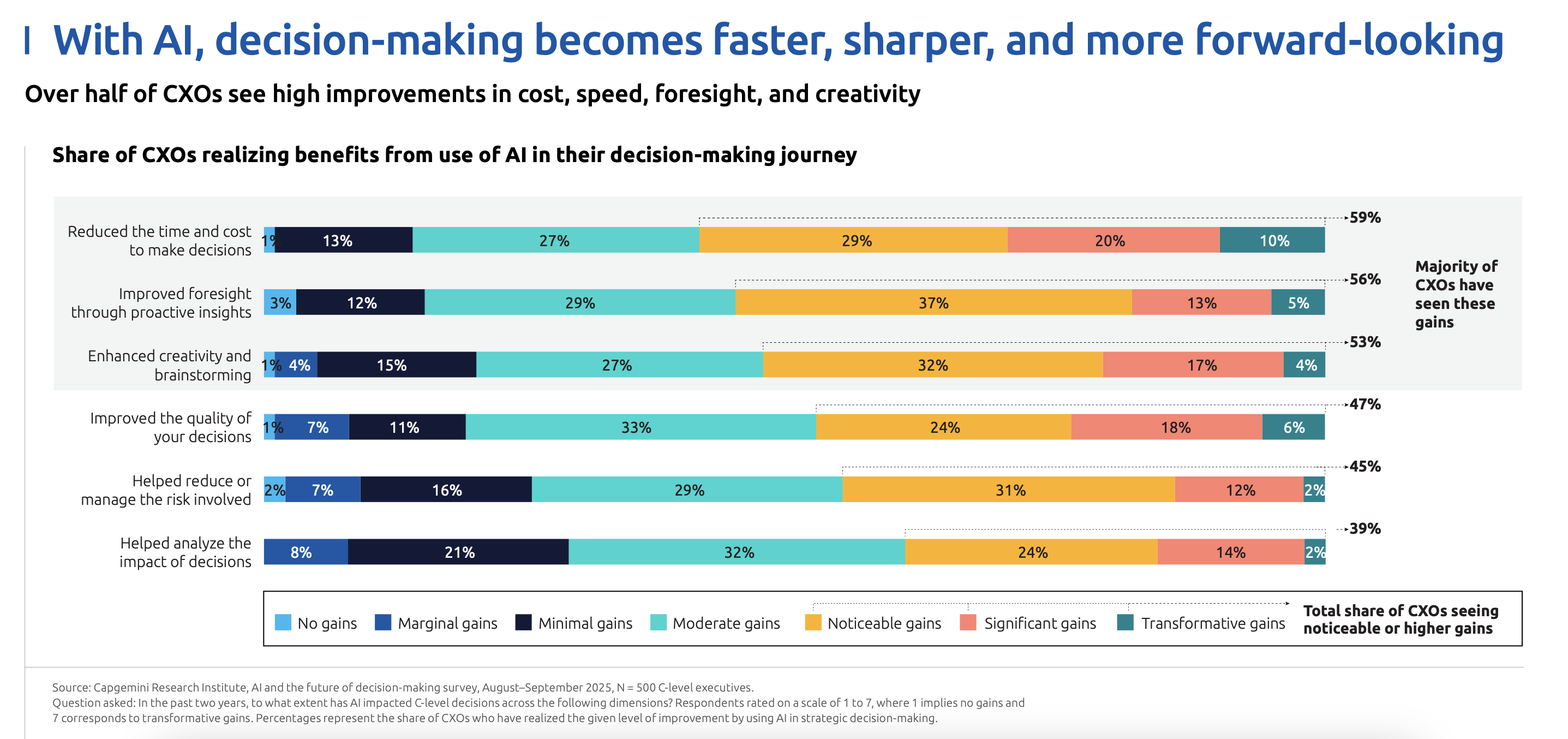
However, AI should support your decisions, not make every important decision for you. You still need to check the information and consider your business context.
What this means for your business: Instead of relying only on intuition, you can use AI to understand your data, spot problems earlier, and make more informed decisions.
3. Improve customer service and response times
Customers expect quick answers. Whether they want to know when an order will arrive, how to use a product, or how to solve a problem, waiting several hours for a response can create frustration.

AI can help businesses provide support more quickly, even outside normal working hours.
For example, AI-powered chatbots can answer frequently asked questions, explain return policies, provide product information, and direct customers to the right resources.
More advanced systems can also connect with company databases to retrieve information about orders, accounts, or previous interactions.
AI can also go beyond answering individual questions. If you want to understand how AI agents can automate more complex tasks and workflows, read our guide: What are AI agents and why do they matter for your business?.
There are already examples of this working at scale.
In its November 2025 report, Agents, Robots, and Us, McKinsey described a large utility company handling more than seven million customer support calls annually.
After introducing conversational AI, the system handled around 40% of all calls and resolved more than 80% of those calls without human involvement. The company also reduced its average cost per call by approximately 50% and increased customer satisfaction by six percentage points.
This is a specific company example, not a result every business should expect. More complex complaints and sensitive situations still need human support.
What this means for your business: AI can help you answer routine questions faster, reduce waiting times, and allow your customer service team to focus on situations that need personal attention.
4. Personalize marketing and customer experiences
Your customers do not all have the same interests. Some are looking for affordable products, while others care more about quality, convenience, or specific features.

Sending everyone the same message may mean missing opportunities to connect with potential buyers.
AI can help businesses understand customer preferences and create more relevant experiences.
By analyzing browsing behavior, previous purchases, and customer interactions, AI-powered tools can help you:
Recommend products based on individual interests.
Create more relevant email campaigns.
Adapt offers to different customer groups.
Generate personalized marketing messages.
Identify which content attracts different audiences.
For example, an online skincare store could recommend different products depending on what a customer has previously viewed or purchased.
Research highlighted by McKinsey in its 2026 article on AI capabilities in marketing suggests that AI-driven personalization can increase customer satisfaction by 15–20%, generate 5–8% more revenue, and reduce the cost of serving customers by up to 30%.
These are potential improvements reported in McKinsey's research, not guaranteed results for every company.
What this means for your business: You can make your marketing more relevant, improve the customer experience, and increase the chances of turning visitors into buyers.
5. Reduce operational costs and improve efficiency
Every business has operational costs. These can include administrative work, document processing, customer support, inventory management, and other everyday activities.
AI can help reduce some of these expenses by automating repetitive processes and making existing workflows more efficient.
For example, businesses can use AI to process invoices, extract information from documents, organize customer requests, or prepare reports.
A real-world example comes from the Franchise Brokers Association (FBA), which needed to review and process lengthy franchise disclosure documents.
According to IBM's report on the benefits of AI for business, the organization introduced AI-powered automation to extract important information from these documents and transfer it into its customer relationship management system (CRM).
The result? The time needed to create a listing fell by 75%, from around four hours to one hour. IBM also reported that calculation errors were reduced to zero.
This shows how automating one specific process can save employees several hours of work.
Of course, AI tools can also create new costs, such as subscriptions, integration, and employee training. You should compare these expenses with the time and resources saved.
What this means for your business: Look for processes that consume a lot of employee time. Automating even one of them can make your operations more efficient.
6. Increase sales and identify new opportunities
AI can also help businesses improve their sales processes and find potential customers.
Sales teams often spend a lot of time researching prospects, preparing emails, organizing customer information, and following up with leads.
AI can help speed up these activities and identify which opportunities deserve more attention.
For example, a B2B company could use AI to organize incoming leads based on their industry, company size, or previous interactions. Its sales team could then prioritize the prospects that are most relevant to its services.
AI can also help you:
Identify potential customers from existing data.
Draft personalized sales emails.
Analyze previous purchases to find cross-selling opportunities.
Recommend relevant products or services.
Review sales conversations and identify common objections.
There is also evidence that AI can support revenue growth in marketing and sales. In its 2026 research on AI and marketing, McKinsey reports that companies it has worked with have achieved 4–7% revenue growth through AI-enabled marketing approaches.
These results depend on how companies use AI, their data quality, and how well they redesign their marketing processes.
What this means for your business: AI can help you understand your prospects, personalize your sales approach, and spend more time on opportunities that have real potential.
7. Detect fraud and improve business security
Businesses handle sensitive information every day, including customer details, payment information, financial records, and internal documents.
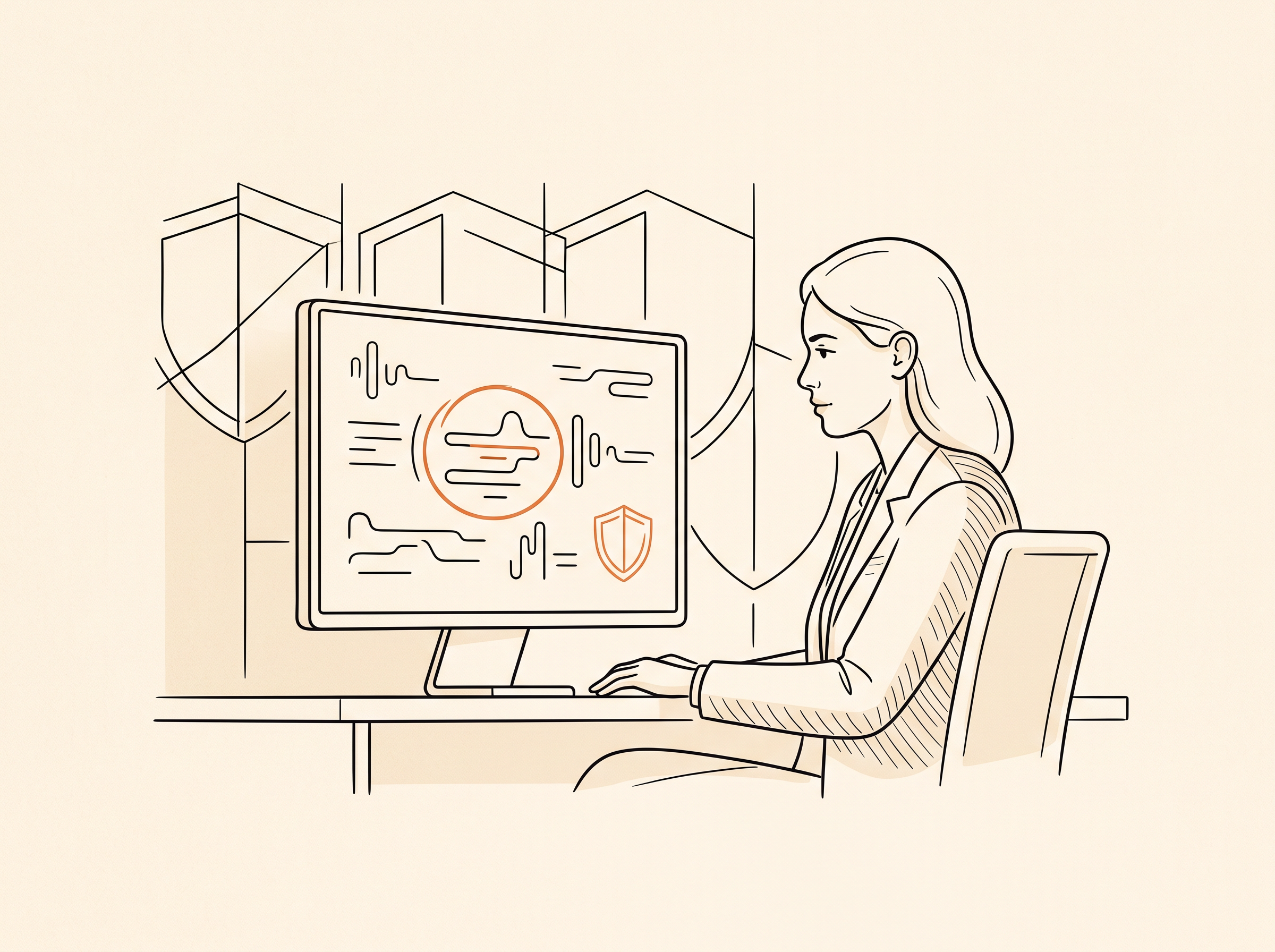
Identifying suspicious activity quickly is important because a security incident can lead to financial losses, operational disruption, and damage to customer trust.
AI can help security teams analyze large amounts of activity and identify unusual patterns that might otherwise go unnoticed.
For example, AI-powered security systems can:
Detect unusual login attempts.
Flag suspicious payment activity.
Monitor network behavior.
Identify potential threats more quickly.
Help security teams investigate incidents.
There is measurable evidence of the financial value of these systems.
According to IBM's 2025 Cost of a Data Breach Report, organizations that extensively used AI and automation in security had an average data breach cost of $3.62 million, compared with $5.52 million for organizations that did not use these technologies.
That represents a difference of $1.9 million per breach.
This is an association reported in IBM's research, not proof that AI alone caused the entire cost difference. Other security practices and organizational factors also matter.
AI systems also need proper protection. IBM reported that 20% of organizations in its study experienced a breach involving shadow AI (the use of AI tools that have not been approved or monitored by the organization).
What this means for your business: AI can help you detect suspicious activity and support your security team, but it should be combined with strong access controls, data protection, and human oversight.
8. Improve inventory management and predict demand
For businesses that sell physical products, managing inventory can be difficult.
Ordering too much stock can leave you with unsold products and unnecessary storage costs. Ordering too little can mean losing sales because popular items are unavailable.
AI can help businesses forecast demand by analyzing historical sales, seasonal trends, promotions, and other relevant information.
For example, an online store selling seasonal products could use AI to analyze previous sales and estimate how much stock it may need in the coming months.
Businesses can use these predictions to:
Estimate future product demand.
Identify seasonal purchasing patterns.
Monitor stock levels.
Reduce the risk of overstocking.
Plan purchases and replenishment more efficiently.
A practical example comes from Indian retailer More Retail Limited (MRL). In a case study published by AWS, the company used machine learning to improve its demand forecasting and automate ordering.
Its forecasting accuracy increased from 24% to 76%. The company also reported up to 30% less waste in its fresh produce category, improved product availability from 80% to 90%, and a 25% increase in gross profit.
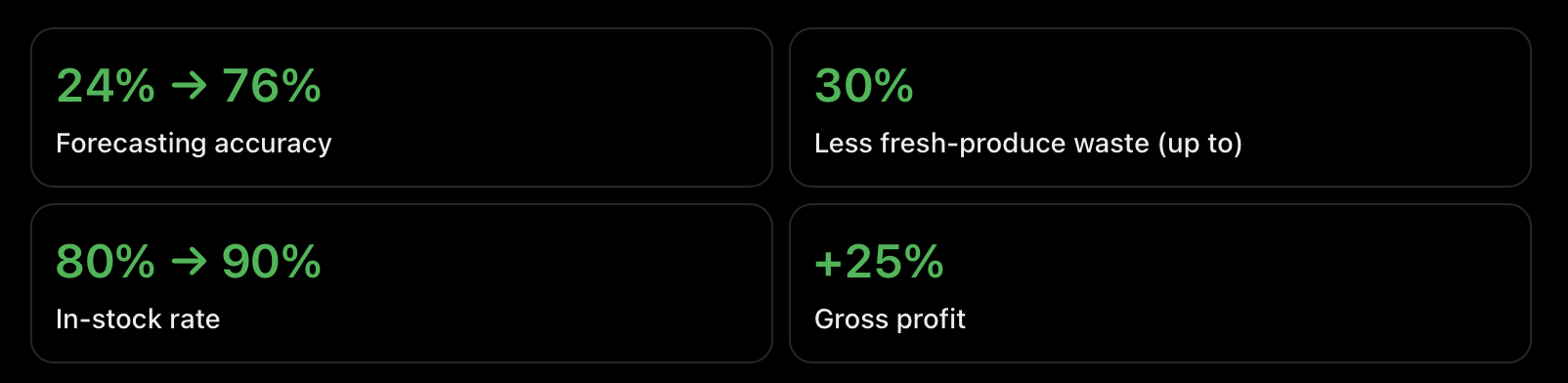
These results came from one retailer's implementation, but they show how better forecasting can influence several parts of a business.
What this means for your business: AI can help you make more informed purchasing decisions, reduce avoidable waste, and keep the products your customers want available.
9. Encourage innovation and develop new products
AI is not only useful for improving existing processes. It can also help businesses explore new ideas, understand customer needs, and develop products or services.
Before launching something new, companies often need to research their market, analyze customer feedback, and test different concepts.
AI can speed up parts of this process.
For example, a software company could analyze thousands of customer comments to identify the features users request most often. A retail brand could use AI to explore product ideas based on changing customer preferences.
Businesses can use AI to:
Analyze customer reviews and identify recurring problems.
Research market trends and competitors.
Generate ideas for new products or services.
Explore different product concepts.
Summarize feedback from customers and employees.
This is more than just a theoretical advantage. In McKinsey's 2025 State of AI survey, 64% of respondents whose organizations regularly used AI said it had improved innovation over the previous year.
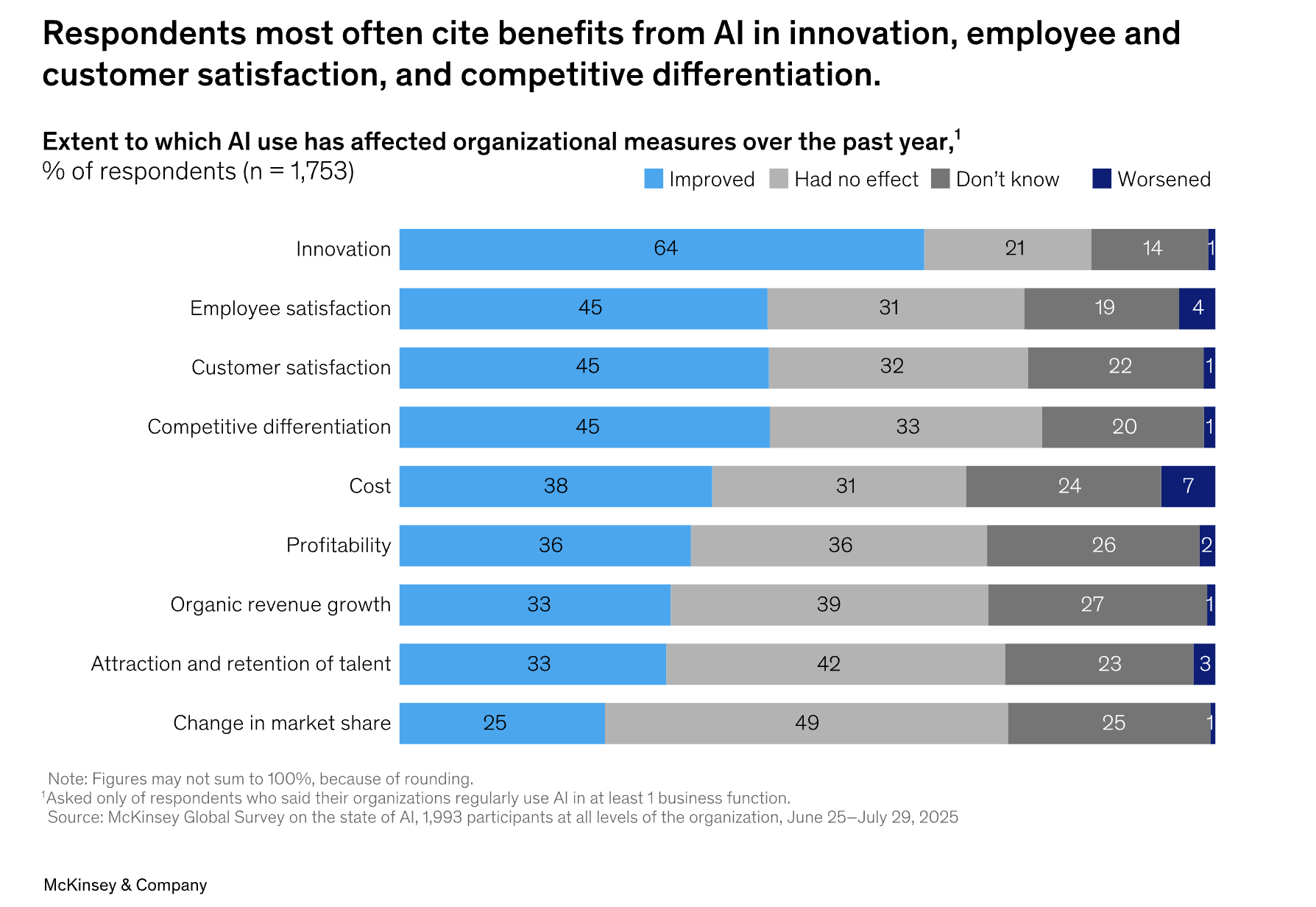
The same survey found that 45% reported improvements in customer satisfaction and employee satisfaction.
These figures reflect respondents' reported experiences, rather than a guarantee that AI will automatically make every company more innovative.
What this means for your business: AI can help you explore ideas faster, understand what customers need, and identify opportunities to improve your products or services.
10. Help employees learn and develop new skills
Another benefit of AI that businesses sometimes overlook is employee learning.

When employees join a company, they need time to understand its processes, products, tools, and internal documentation. Finding the right information can be difficult, especially when knowledge is spread across multiple documents and systems.
AI assistants can make this information easier to access.
For example, an employee could ask an internal AI assistant how to complete a specific process, where to find a document, or how a particular tool works.
AI can also help companies:
Create training materials and practice exercises.
Explain complex topics in simpler language.
Summarize internal documentation.
Help employees learn new software.
Provide feedback on written work.
Research also suggests that AI can help less experienced employees improve their performance.
The previously mentioned study published in The Quarterly Journal of Economics found that the productivity gains from AI assistance were particularly strong for less experienced and lower-skilled customer support agents. The earlier NBER research paper reported productivity improvements of up to 34% for novice and lower-skilled workers.
The researchers also found evidence that AI helped less experienced employees learn from the practices of more experienced colleagues.
What this means for your business: AI can help employees access information, learn processes faster, and become more confident when handling unfamiliar tasks.
Research findings and business cases
These reported results come from different surveys, studies, and company cases. They describe specific contexts, not guaranteed outcomes for every business.
Source and context | Reported figures | Context |
AI use in at least one business function: 55% (2023) and 88% (2025); generative AI use in at least one function: 70%. | Surveyed organizations. | |
5,172 customer-support agents; AI assistance increased customer issues resolved per hour by 15% on average. | Specific customer-support task; the article notes this does not mean every employee becomes 15% more productive. | |
80% of respondents said AI improved individual productivity; 37% reported AI contributed to their organization's EBIT. | Individual productivity does not automatically mean a measurable increase in company profit. | |
47% of surveyed senior executives reported improved decision quality after using AI. | Surveyed senior executives. | |
A utility company handled more than seven million support calls annually; conversational AI handled around 40% of calls and resolved more than 80% of those without human involvement; average cost per call fell approximately 50%, and customer satisfaction rose six percentage points. | One large utility-company case. | |
Reported potential improvements: customer satisfaction 15–20%, revenue 5–8%, and cost of serving customers up to 30% lower. | Potential improvements highlighted in the research, not guaranteed results for every company. | |
Average breach cost: $3.62 million for organizations extensively using AI and automation in security versus $5.52 million for organizations not using them; $1.9 million difference. 20% experienced a breach involving shadow AI. | Reported association, not proof that AI alone caused the cost difference. | |
Forecast accuracy: 24% to 76%; up to 30% less fresh-produce waste; availability: 80% to 90%; gross profit: +25%. | Results from one retailer's implementation. | |
Listing creation time fell 75% (around four hours to one hour); calculation errors were reduced to zero. | Reported result from the case described in the article. | |
64% of respondents at organizations regularly using AI said it improved innovation over the previous year; 45% reported improvements in customer satisfaction and employee satisfaction. | Respondents' reported experiences. |
Quick overview: 10 benefits of AI in business
Benefit | How AI can help |
1. Increase productivity | Automate repetitive tasks and save time |
2. Improve decision-making | Analyze data and identify useful patterns |
3. Improve customer service | Answer routine questions and reduce waiting times |
4. Personalize marketing | Create more relevant customer experiences |
5. Reduce operational costs | Improve processes and use resources efficiently |
6. Increase sales | Identify promising leads and sales opportunities |
7. Improve security | Detect suspicious activity and potential threats |
8. Predict demand | Improve inventory and supply chain planning |
9. Encourage innovation | Explore ideas and develop new products |
10. Support employee learning | Make knowledge and training easier to access |
How to start using AI in your business
You do not need to transform your entire company overnight to benefit from AI. Starting with one specific problem is often a better approach.
Here are five steps to help you get started.
1. Identify a task that takes too much time
Look at your daily operations. Are employees spending hours answering the same questions, preparing reports, organizing data, or creating content?
Start with a task that is repetitive and relatively easy to measure.
2. Choose an AI tool that matches your needs
Different tools solve different problems. For example:
ChatGPT can help with writing, research, brainstorming, and data analysis.
HubSpot offers AI features for marketing, sales, and customer relationship management.
Zapier can connect applications and automate workflows.
Neopress helps businesses create and manage websites through AI chat, including creating pages, publishing content, and working on SEO.
If you're considering creating a website for your business with AI, explore our comparison of The 10 best AI website builders to try in 2026.
3. Start with a small project
Rather than introducing AI across your entire company, test it in one area first.
For example, you could use an AI assistant to draft customer emails or automate the process of organizing incoming requests.
This makes it easier to understand what works before expanding its use.
4. Measure the results
Do not assume that a tool is useful simply because it uses AI.
Compare the results before and after introducing it. You could measure:
Time saved on a particular task.
Number of customer requests handled.
Cost per completed task.
Sales or conversion rates.
Employee satisfaction.
These measurements will help you decide whether the investment makes sense.
5. Keep human oversight
AI can make mistakes, misunderstand information, or generate inaccurate answers.
Employees should review important outputs, particularly when they involve financial decisions, customer data, legal information, or business strategy.
The best results usually come from combining AI's speed with human experience and judgment.
What are the limitations of AI in business?
Although AI offers many benefits, it is important to have realistic expectations.
Before adopting an AI tool, consider a few potential challenges:
Inaccurate information: AI can generate convincing answers that are incorrect. Important information should always be checked.
Data privacy: Businesses need to understand how their information is stored, processed, and used by AI providers.
Implementation costs: Some tools require subscriptions, technical integration, or employee training.
Employee training: Your team needs to understand how to use AI effectively and when not to rely on it.
Human judgment: AI cannot fully replace human responsibility, particularly for sensitive or complex decisions.
There is also a difference between improving individual tasks and transforming an entire company.
McKinsey's 2026 State of AI survey found that 80% of respondents said AI had improved their individual productivity, but only 37% reported that AI had contributed to their organization's EBIT (earnings before interest and taxes, a measure of operating profitability).
This is an important distinction: employees can save time with AI without the company automatically seeing a measurable increase in profit.
To get real value, businesses need to connect AI tools to clear objectives and well-designed workflows.
Final thoughts
AI can bring real benefits to businesses, from saving employees time and improving customer service to identifying sales opportunities and supporting innovation.
But the biggest advantage is not simply using more AI tools. It is understanding where your business needs help and choosing the right technology to solve those problems.
You can start small, measure the results, and gradually introduce AI into other parts of your operations.
Whether you run a small online store, a marketing agency, or a growing company, AI can become a useful part of how you work, as long as you use it with a clear purpose.
FAQ:
What are the main benefits of AI in business?
The main benefits include increased productivity, better decision-making, improved customer service, personalized marketing, lower operational costs, increased sales opportunities, fraud detection, better inventory management, innovation, and employee training.
How can small businesses benefit from AI?
Small businesses can use AI to automate repetitive tasks, create marketing content, answer common customer questions, analyze sales data, and manage everyday operations. Many AI tools are available through subscriptions or free plans, so businesses do not always need a large technical team to get started.
Can AI reduce business costs?
Yes. AI can help reduce costs by automating manual tasks, improving inventory management, speeding up customer support, and identifying inefficient processes. However, the actual savings depend on implementation costs, the type of business, and how effectively the technology is used.
Does AI increase business revenue?
AI can support revenue growth by helping businesses identify potential customers, personalize marketing campaigns, improve sales processes, and develop new products. However, using AI does not guarantee higher revenue. Results depend on the business strategy and the quality of implementation.
Will AI replace employees in businesses?
AI can automate certain tasks, but it does not automatically replace entire jobs. In many situations, it works as an assistant that helps employees complete tasks faster, access information, and focus on more complex responsibilities. Human judgment, communication, and decision-making remain important.
Newsletter
A sharper growth note, once in a while.
Get practical SEO strategies, SSR guides, and AI search insights delivered directly to your inbox.
We respect your privacy. Unsubscribe at any time.